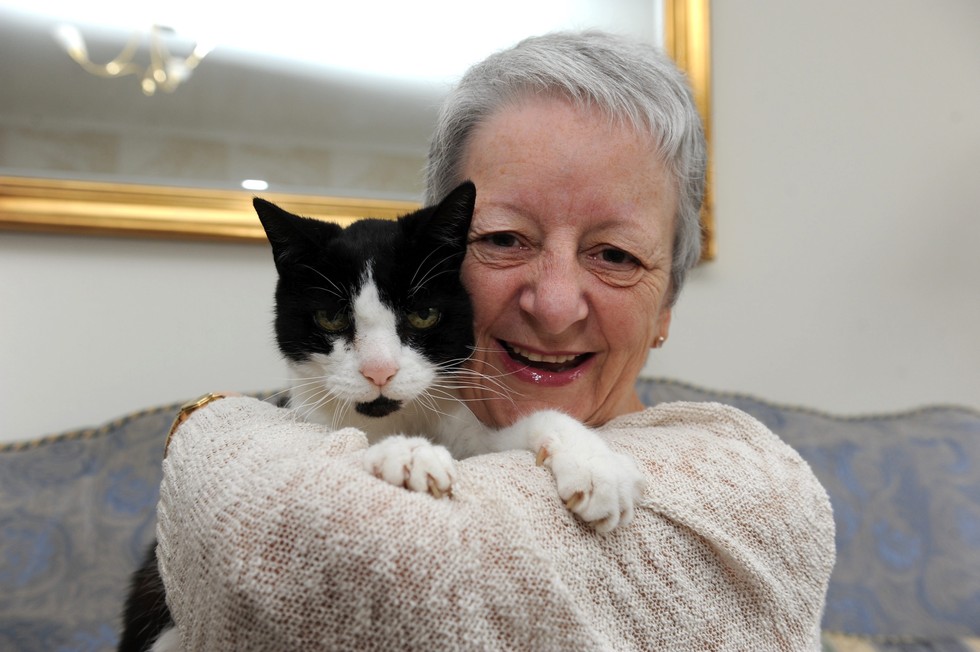
Some people think they’re cute, while others think they’re creepy. But there’s no doubt recognizable and a little strange looking: Lykoi cats – also known as “werewolf cats” because of their looks – have taken the Internet by storm.
According to ABC News, the far-out felines not only resemble the mythical canine creature but also behave like dogs – tail-wagging and all.
>> Read more trending stories
“The first kittens, they looked like little hunting dogs running around on the carpet,” founding breeder Johnny Gobble told ABC News. “I thought it was neat.”
The International Cat Association says the breed, started in 2011, resulted from natural mutations in domestic shorthair cats. But some animal lovers aren’t so sure about that.
“There’s people out there that hate me because they think I spliced DNA,” Gobble said – a charge he denies.
The cats usually cost about $1,500 to $2,500, the Huffington Post reports.
Sep 19, 2015 … Remember the two ginger kittens that swam their way to a fishermen’s boat to be rescued? We’ve got updates on the two kitties. Here is a picture of the two cuties relaxing after. They are a little bigger now than when we first saw them.
The 2 brave ginger kittens that swam to the boat and then were rescued by fishermen Jason Frost and Brandon Key are doing very good at their forever home where they have been named Warrior and River.
We all know about leopards, tigers, lions, cougars, and jaguars, but there’s a whole world of rare wild cat species that exists, that are small and/or weird varieties that you’ve probably never seen or even heard of!
Cats evolved into a distinct family (Felidae) roughly 25 million years ago. Since then, they’ve expanded all over the world and have evolved to match their environments. They still retain some things in common, however – just like your fluffball at home, very few cats can taste sweetness. They are all obligate carnivores – they do not simply favor meat, they can’t subsist on anything else. Besides lions, very few cats display any sort of strong social behavior, though some others do hunt together or form loose colonies. It’s no wonder our domesticated kitties are such haughty, individualistic souls! (Source: BoredPanda.com)
Here are a few of the cats that you have never heard of or even seen before. These cats are located around the world.
1 Sand Cat (Felis Margarita)
Source Imgur
This is one of the more difficult cats to study in the wild. Their foot coverings allow them to walk on sand without sinking, leaving their footprints nearly invisible. They have learned to crouch down and shut their eyes when a light is shone on them, which prevents the light from reflecting their eyes for tracking. That combined with their protective coat color makes them blend right into their habitat. They also bury all of their excrement making it impossible to find and analyze so their diet can be studied.
Habitat: Sandy and stony deserts.
Distribution: From the Sahara through the Middle East to Turkestan.
The black-footed cat is perhaps the smallest species of wild cat in Africa, black-footed cats average only 2.4 lb. to 4.2 lb. when fully grown. As with many other animals the females are usually smaller than the males.
Head and body length (not counting tails): The males are around 14 to 17 inches long. Their tails are about 6 to 8 inches long. Again females are normally smaller than the males.
Height: The males are usually around 8 to 10 inches tall when measuring that the shoulder.
Habitat: Black-footed cats are nocturnal inhabitants of the arid lands of southern Africa, and are typically associated with open, sandy grassy habitats with sparse scrub and tree cover. Although poorly studied in the wild, optimal habitat seems to be savannah areas having long grass with high rodent and bird densities. During the day, they live in abandoned burrows dug or in holes in termite mounds.
During the course of a year males will travel up to 8.5 sq. mi. while females travel up to 4 sq. mi. A male’s territory overlaps the territories of one to four females.
Distribution: Black-footed cats are native to arid regions of the southern parts of Africa like Nambia, Zimbabwe, Angola but not is the driest or sandiest parts of the Namib or Kalahari deserts. Before its numbers decreased so much it had once been known to inhabit Botswana. Sadly, none have been seen in Botswana for a long time. (Source: BigCatRescue.org)
Named for the large cloud-like spots on its body, the clouded leopard is a medium-sized cat that sports a grayish or yellowish coat. The spots, which are generally dark brown with a black outline, provide excellent camouflage in the leopard’s forest habitat. Clouded leopards have long, strong tails and powerful, stout legs. They are also known to be one of the best climbers in the cat family.
Historically clouded leopards were found in much of Southeast Asia from Nepal to southern China. Today, four subspecies are found in the following regions: Nepal to Burma; southern China to eastern Burma; Sumatra, Borneo and Java; Taiwan (thought to be extinct in the wild). The Bornean clouded leopard has been identified as a new cat species. (Source: Defenders.org)
Pallas’s cat (Otocolobus manul) is about the size of a domestic cat but looks much larger due to its stocky build and long, dense coat, which helps shield it from the cold in its frosty habitat (2)(5). The fur, which is nearly twice as long on the underparts and tail as it is on the top and sides (5), seasonally changes colour, from a frosted grey in winter to a grey/fox-red in the spring. Hair length and density also varies seasonally, being longer and heavier in the cold seasons (6). The short, stocky legs are marked with indistinct black bands and the bushy black-tipped tail is encircled with dark rings towards the end (5). Contrasting patches of pale white-cream fur exists on the chin, throat, inner ears and just beneath the eye, while two dark stripes run diagonally across each cheek and the crown is patterned with little black spots (5). The colour and patterning of the hair provides Pallas’s cat with a high level of camouflage and amongst rocks it can remain perfectly concealed (6). The small, rounded ears are set low on the sides of the short, broad head, an adaptation to stalking prey in open country where there is little cover (3)(5). Unlike other small cats, the pupils in the large eyes of Pallas’s cat contract to small circles rather than slits (3).
Widely distributed but rare, Pallas’s cat is found from the Caspian Sea in the west through Kazakhstan, Pakistan and northern India to parts of China and Mongolia (4). The species is now thought to be most abundant on the cold grasslands of Mongolia, Inner Mongolia and the Tibetan Plateau. Elsewhere it is considered vulnerable to rare and uncommon (5). (Source: Arkive.org)
This week’s cat of the week fell in love with his neighbor’s stuffed tiger — so he did what any cat would do: He stole the tiger and ran off with it. Now the pair is absolutely inseparable and NOTHING will bring them apart. Lil’ thief.
But while the cat of the week was busy sleuthing and thieving, the rest of Cat Country was putting together their plan for world domination. Let’s go over the highlights, shall we?
1) Buzz the Fuzz survived a hard start to life to become a therapy cat and spend his time giving love to those in need.
4) Cassidy the miracle kitten made an amazing recovery and no longer needs his little wheelchair to get around.
5) A litter of tiny kittens were reunited with their mom after they were abandoned — and it was the cutest family reunion ever.
Sweet kitties.
In other corners of Cat Country, cats were making a huge effort to confuse the heck out of dogs— as if their relationship wasn’t strained enough already. But if dogs will never be a perfect match for kitties, computers will always be there for your feline. Seriously, why do cats love laptops so much?
Kittens proved to be pioneers this week when a group of fluffy babies decided to travel around in Uber cars to give free cuddles to those in need. Truly inspiring.
Another group of shelter cats stepped into the spotlight this week when they dressed up in adorable Halloween costumes. ‘Tis the season, after all!
What a wild week in Cat Country — but the madness doesn’t end here! Stay tuned to see what these felines are up to next week.
And those were the top links! Now we have Horoscope Cat back on the panel to tell you what your November is going to be all about. Take it away, Horoscope Cat!
November is almost upon us, and that means one thing and one thing only—the full tummy planets have aligned with the cozy planets. Yes folks, the greatest season in the world has arrived — and it’s time to make the most of it.
The romance moons have orbited out of your relationship sector in the beginning of the month, but don’t fret about it. You’ll have plenty of snacks to make up for the lack of romance in your life during the week of the 19th—plus, who really needs someone else’s fluff when you’ve got your own? That’d just be too many hairballs in the house.
The end of November will bring the best friend planet into full swing. Lots of friends will come into your life, so keep your arms open for plenty of hugs and snuggles. That’s all you really need in life anyway, right?
The Somali cat is called the fox face cat because it resembles a fox. The Somali cat enjoys life and loves to jump, play and climb everything. This is a highly intelligent and inquisitive cat that nothing escapes. This cat is mischievous and somewhat like a monkey with its’ antics.
History
The Somali is the longhaired variety of the Abyssinian, a cat whose origin is surrounded by many romantic tales. Despite his name, he’s not from Somalia (the next door neighbor to Ethiopia, formerly known as Abyssinia) but more likely the coast of the Indian Ocean and parts of Southeast Asia. He resembles a small African wildcat but is domestic through and through. Breeds that probably figured in his background include Siamese, Burmese and Russian Blues. The longhaired gene was introduced after World War II when breeders were trying to bring the breed back after the privations of the war.
It wasn’t until the 1960s that Somalis truly began to be developed as a breed. The Aby is highly popular, but the Somali is less well known.
The Somali is a medium-sized cat with a long body and nicely developed muscles.
The Somali is moderate looking in all aspects with smooth planes on her head. She has a gentle dip in the triangular head. Her rather large ears sit tilted forward giving her an alert, aware look as if she is always paying attention to everything. The eyes, which look large in the face, show the alertness and intelligence inherent in the breed.
The coat on the Somali is full with exaggerated tufts of hair in the ears. The fur is soft without being woolly and the tail is fluffy like a fox’s tail. The coloring of the Somali is special. The majority of the fur has bands of color on each individual hair, with the coat looking darker along the spine line. The color on the body softens and lightens under the neck and the underside of the cat and the insides of the legs. She has a wild look about her, but is not at all extreme except in the color of the fur, which carries bands of color giving her a richness and depth not seen in other breeds.
With all the virtues of the Abyssinian and adorned by a gorgeous semi-long coat, the Somali is a beautiful and lively addition to any household. Don’t get a Somali if you want a cat that can be taken for a furry doorstop, or if you want a cat that will do your bidding. Like the Abyssinian, the Somali is active, curious, and high-spirited, and loves to prance around the house, opening cupboards and generally getting into mischief. Their voices are soft, their minds active, and their food dishes are always empty. They also tend to be determined cats: Once they get an idea in their furry little heads, there’s no dissuading them. They’re not aggressive or unfriendly, just tenacious.
Somalis are affectionate, but are not lap cats. They don’t like to be cuddled and would rather be near than on you. They do, however, want to be involved in every aspect of your life. Open a drawer and your Somali will be there to peer in.
Though this breed is generally healthy and vigorous, they occasionally have problems with gingivitis, tooth decay, and amyloidosis — protein buildup in the organs. It should be noted that these problems are no more prevalent in the Somali than in any other breed. Another common affliction for all breeds of cats is feline infectious anemia (FIA). Less common in cats (more in dog breeds) is auto immune mediated hemolytic anemia (AIHA), but at least one breeder has reported that some lines of Somali are more prone to this condition.
Because the treatment for each condition is very different, if your Somali is showing signs of anemia, it is recommended that you ask your veterinarian to perform a blood work-up, including a packed cell volume (PCV) test.
The medium length coat of the Somali needs a moderate amount of grooming. Comb the coat once or twice a week with a stainless steel comb to remove dead hair, prevent or remove tangles, and distribute skin oils. In the spring, when the cat is shedding his winter coat, you may need to comb him daily. A bath when the cat is shedding will help to remove excess hair more quickly. Check the tail for bits of poop stuck to the fur and clean it off with a baby wipe.
Brush the teeth to prevent periodontal disease. Daily dental hygiene is best, but weekly brushing is better than nothing. Trim the nails every couple of weeks. Wipe the corners of the eyes with a soft, damp cloth to remove any discharge. Use a separate area of the cloth for each eye so you don’t run the risk of spreading any infection. Check the ears weekly. If they look dirty, wipe them out with a cotton ball or soft damp cloth moistened with a 50-50 mixture of cider vinegar and warm water. Avoid using cotton swabs, which can damage the interior of the ear.
It’s a good idea to keep a Somali as an indoor-only cat to protect him from diseases spread by other cats, attacks by dogs or coyotes, and the other dangers that face cats who go outdoors, such as being hit by a car. Somalis who go outdoors also run the risk of being stolen by someone who would like to have such a beautiful cat without paying for it.
The information in this article was curated from various sources. Each source was credited at the end of the particular section. For more information regarding the Lambkin cat, please visit any of these sources: cattime.com
Sometimes cats can drive you crazy with the things that they do. However, they can also help us in ways that you would not believe. Cats have a lot of the same diseases that human have and maybe sometimes they can sense if we have a problem. That was the case in this article found on The Dodo.com. A cat owner’s was saved by her cat, when it noticed something wrong.
Sue McKenzie took in her beloved cat, Tom, when he was a stray kitten 20 years ago. The two share a close bond — so close, in fact, that Tom actually sensed when 64-year-old McKenzie was ill and alerted her.
“Tom doesn’t actively seek out human contact so I thought he was behaving very strangely when he suddenly started pawing me,” McKenzie told ITV News. “He would pat my the back of my neck while meowing very loudly.”
Tom kept tapping the same spot on McKenzie’s neck — he was so persistent it was starting to drive her crazy.
McKenzie finally had the spot checked out and doctors found a lump — they diagnosed her with Hodgkin’s lymphoma. Suddenly, McKenzie realized Tom hadn’t been trying to annoy her — he’d been trying to warn her.
Some cats are so laid back, that even a snail can hang out with them. That’s the case in article written by Hilary Hanson News editor, The Huffington Post.
Sometimes you just gotta relax and take things slo-o-ow.
What better way to do that than with a blissed-out cat and a charming snail atop his paw?
Unfortunately, a second feline seems intent on ruining the idyllic scene, sticking its face up against the snail and aggressively sniffing it.
The Dodo suggests that viewers “pretend that these cats found a lonely snail and took him in to raise him as their own kittens,” but frankly it looks more to us like the cat is scoping out the snail as a potential snack.
That being said, the calmer of the two cats appears to have a history of hanging out with snails. The Japanese-language YouTube channel that posted the video last week also uploaded this one back in July: